
Fundamentals
Greeting
Greet every customer the moment the door opens! Why? It lets customers know they've been seen, and gives them hope they will receive service quickly. Even when the store is super busy, don't work with blinders on as though you didn't see the new customer! Look up and greet, and point out an open seat, or indicate where and when a seat may become available.
Use Nice Words
Talking nicely and using good language shows respect. Use these standard phrases with customers.
- Welcome to George Webb
- How may I help you?
- Are you ready to order?
- May I take your plate?
- Is there anything else I can get you?
- Thank you.
No "Sweetie, Honey, Hun, or Dear"
Unless it's your significant other, children, parents, friends, -- not a stranger at the table, never utter these mushy terms of endearment. Customers don't like it, and some are actually offended by it. What should you use? Nothing, or sir, or mam, or their name, if you know it.
Service with a Smile
- Smile
- Show kindness
- Be friendly
- Be quick about your service
- Keep an eye on the table whenever you pass by
- Collect the dishes as everyone has finished eating. This encourages tipping and helps to turn tables.
- Be prompt to collect. If the customer has to wait to pay, it discourages a tip.
Ten Steps of Customer Service
More Tips for Successful Customer Service
- Show kindness
- Let Customers Have Their Say
- Keep your cool. Never argue back to a customer! Getting angry will make the situation worse!
Examples:
Customer: "My ordered still hasn't arrived. I want my money back."
You: "I'm sorry, let me check on it immediately."
Beverage Service
Coffee Service
- Initially bring the cups to the table along with the coffee pot when possible.
- Pour coffee at the table whenever practical to demonstrate freshness, temperature, and quality.
- This is especially important during slower periods or when first serving coffee.
- During busy periods, efficiency takes priority, but service should still be prompt and attentive.
Coffee Refills
- Customers should never feel they have to ask for coffee. Stay aware and anticipate refills.
- Keep an eye on cups and offer refills promptly, especially during breakfast.
- When refilling one guest, check others at the table.
- Always ask before refilling. Do not assume.
- Many customers prefer their coffee a certain way (cream, sugar, temperature) and may not want more.
- Do not automatically top off partially full cups without asking. This creates waste.
- Provide one to two refills as expected service. Do not continue refilling excessively.
- After one or two refills, pause and wait for the customer to request more.
- Refills should be poured at the table. Do not take cups away to refill them.
Refill Limits and Beverage Types
- Free refills apply to brewed coffee and fountain soda only.
- Offer one soda refill. Additional refills should not be routinely offered.
- No free refills on lemonade, juices, milk, or hot tea.
- These beverages have a higher cost and must be purchased again if the customer wants more.
To-Go vs. Dine-In Coffee Policy
- Refills are based on the type of service purchased, not the container used.
- Dine-in coffee in standard cups includes refills while the customer is in the restaurant.
- To-go coffee does not include free refills, even if the customer is dining in.
- Do not provide refills or top-offs in to-go cups.
- If a customer requests a to-go cup while dining in, ring it in as a to-go coffee.
- If a customer wants refills, offer to serve the coffee in a dine-in cup instead.
- If a customer asks for a final refill in a to-go cup, politely explain that another coffee must be purchased.
- Customers requesting dine-in coffee in a to-go (styro) cup should be charged as a to-go coffee.
- Managers may approve exceptions for service recovery or special situations.
- Servers should not make exceptions on their own.
Server Script – Beverage Communication
- Offering coffee refill:
- “Can I warm that up for you?”
- After one or two refills:
- “Would you like a little more, or are you all set?”
- Soda refill:
- “Can I get you one more refill?”
- Redirect to dine-in cup for refills:
- “If you'd like refills, I can bring that in a dine-in cup for you.”
- Declining refill in to-go cup:
- “I’m sorry, our to-go coffees don’t include refills, but I can get you another one.”
- Declining “final to-go refill”:
- “I can get you a fresh to-go coffee for the road if you'd like.”
Soda Service and Ice Handling
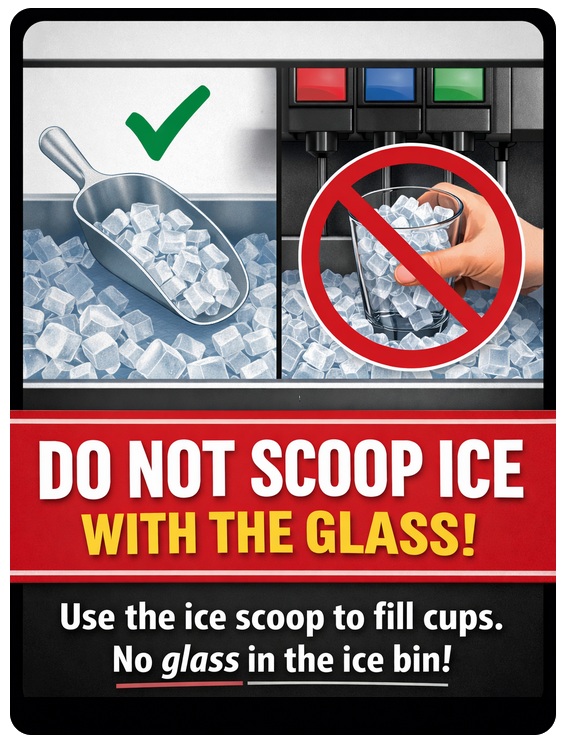 Ice must always
be handled properly to prevent contamination.
Ice must always
be handled properly to prevent contamination.
- Always use the designated ice scoop stored outside the ice bin.
- Never place a drinking glass directly into the ice bin.
- Hold the glass outside the bin and use the scoop to transfer ice into the glass.
- Do not touch the ice with your hands or with the rim of the glass.
- Return the scoop to its proper holder after use.
Customer Complaint
Late in getting to the customer? Food took too long? Forgot a
beverage? It's not the occasional lapse in service that results in us
loosing customers, it's failure to show sincere concern.
Recover from a Complaint
Follow this two-step process in order to "recover" the situation:
- Take Action. It doesn't matter whose fault
it is. Resolve it!
- "Thank you for waiting, how can I help you?"
- "I'm sorry about that, let me fix it!"
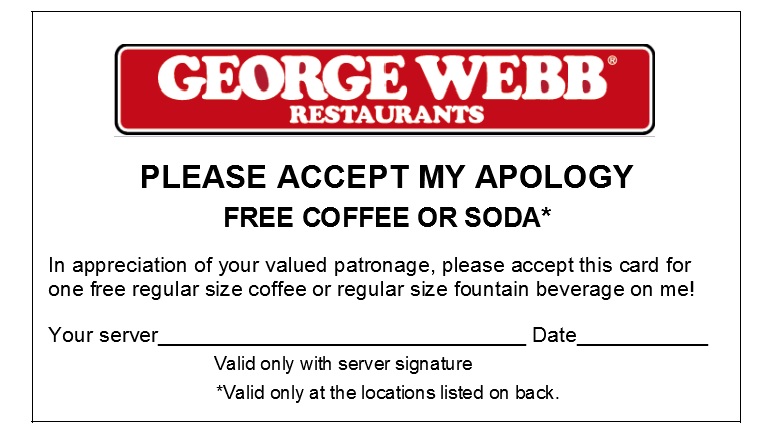
- Issue an Apology Card. Use the opportunity to drive home the point that we value our customers.
Is the Manager Here?
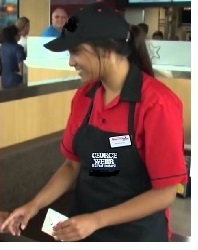
We don't always have a manager on duty. So if you get "I want to talk to a manager", ...know that you and others are capable of handling customer service issues. So rather than to say the manager isn't here right now, say: "I am capable of solving your problem. how may I help you?".
Be a "Runner"
It takes longer to prepare the food than it takes to take the order. So the kitchen becomes a "bottleneck". So to expedite things, "run" back and assist and coordinate the activities of the cook. The faster the food comes out, the faster people are served and will more likely tip and turnover the table.
Pre-Clear Dishes
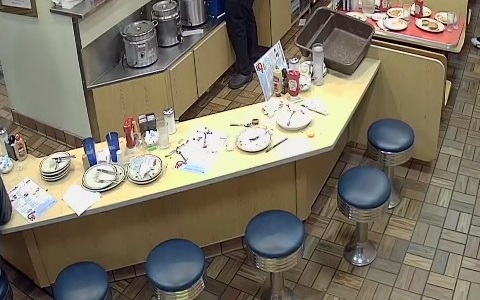
Does this look appealing --->?
This is what happens when the server doesn't "pre-clear" the customer's main dish while the customer is still seated. As you can see, pre-clearing is a a vital step to keeping the restaurant looking tidy.
Where to Pre-clear the Dishes
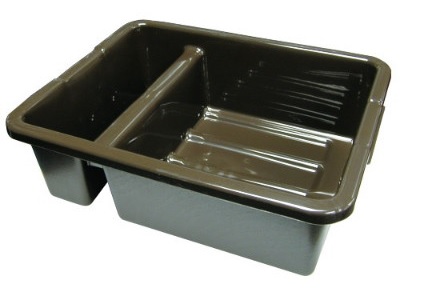 Don't clutter the sink with dirty
dishes. Pre-clear into a bus pan. Keep bus pans handy on the lower shelf
of the customer counter and at a nearby bus-cart.
Don't clutter the sink with dirty
dishes. Pre-clear into a bus pan. Keep bus pans handy on the lower shelf
of the customer counter and at a nearby bus-cart.
Maintain the Sanitizing Solution Bucket
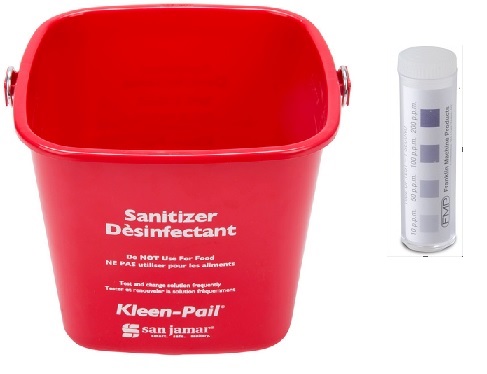 Use a clean wiping cloth and the bleach water in
the red bucket to wipe and sanitize the:
Use a clean wiping cloth and the bleach water in
the red bucket to wipe and sanitize the:
- tables and seating after each guest
- menus after each use
Check the Sanitation Solution in the Red Bucket
All wiping cloths should be stored in the red bucket with sanitizing solution. Change the bucket often and test the solution, every 2 hours or more depending on usage. Use test strips found on the wall. It's a simple process of inserting a test strip into the bucks. It should read between 200-400 ppm.
Towel
Usage Policy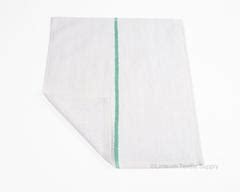
Proper use and management of our bar towels are essential for maintaining cleanliness, efficiency, and cost control. These towels are a shared resource with a set weekly supply, and improper use or wastefulness negatively impacts our ability to maintain a clean and functional work environment.
Types of Use
1. Light Use (Sanitizing & Wiping Customer Areas)
- Towels used for wiping and sanitizing customer tables, counters, beverage stations, and other minimally greasy surfaces.
- These towels must be stored in a sanitizing solution between uses to maintain proper sanitation.
- When a towel becomes too soiled for presentable use in these areas, do **not** discard it immediately. Instead, hang it to dry on the designated towel racks above the linen bag.
2. Heavy Use (Kitchen & Greasy Surfaces)
- Towels used for wiping greasy griddles, egg stoves, grill boards, and other heavily soiled areas.
- Before taking a new towel for these tasks, first check and use the hung-to-dry towels that were previously designated as too soiled for light-duty use. These still have useful life for tougher cleaning jobs before being discarded into the linen bag.
Key Expectations:
- Do not waste towels. We receive a limited number each week, and once they are gone, we are out until the next delivery.
- Follow the proper towel cycle. Light-use towels should be repurposed for heavy-use cleaning before being discarded into the linen bag.
- Be mindful of costs. Each towel has a laundering cost, and excessive waste is financially irresponsible.
- Use towels efficiently. If a towel can still be used for another task, do not prematurely discard it.
Failing to follow these guidelines results in unnecessary shortages and increased costs. Treating our towels like they are unlimited is short-sighted and irresponsible. Everyone is responsible for ensuring we use this resource wisely. Thank you for your cooperation.
Reset Tables
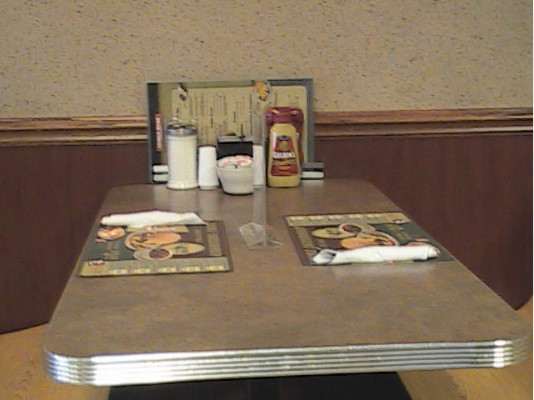
Doesn't this look nice --->?
Clear and reset tables before anything else. Before doing dishes, before taking breaks. The place needs to look organized and presentable.
- Wipe the table
- Pull the condiments away from the menu holder and wipe underneath
- Arrange the setups
- Set out placemat and rolled silverware
- Table tent in the middle
All tables and the counter seats must have placemats and table tents at all times!
Like This!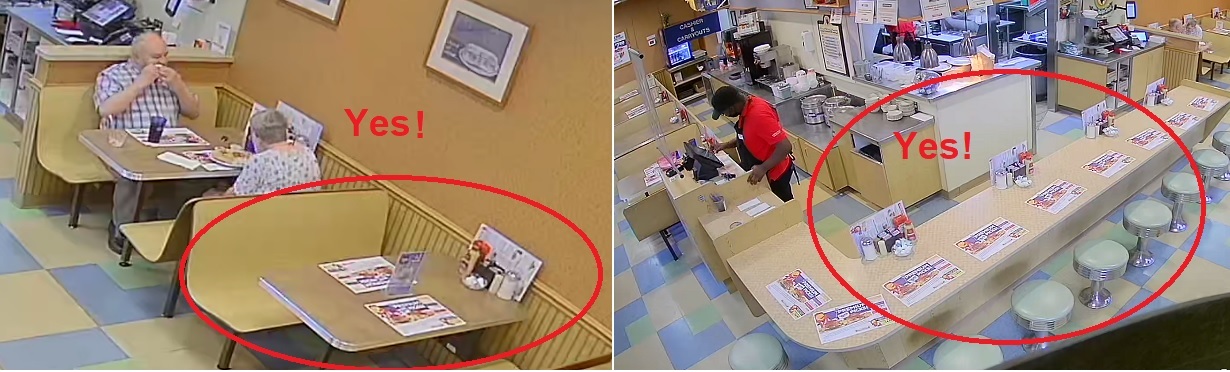
Not this! 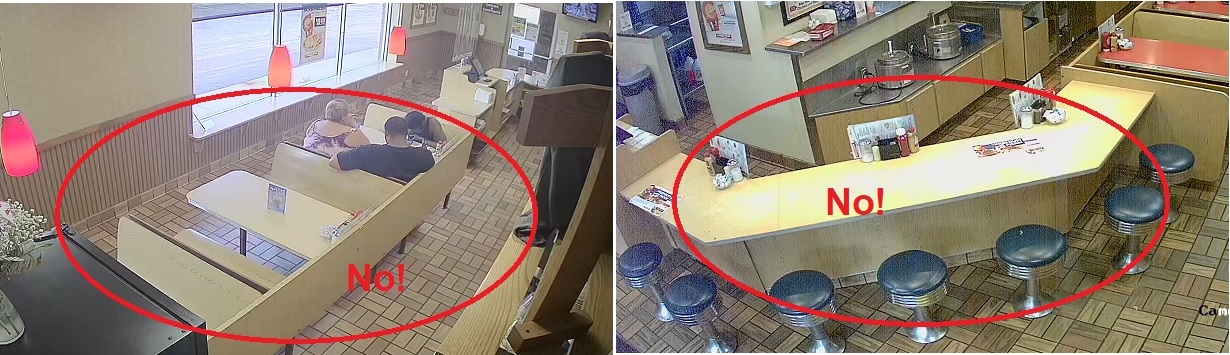
Answering
the Phone and Phone Orders
Please make every effort to excuse yourself and answer the phone.
How to Answer the Phone
" Hello, George Webb's on __(street)___, _this is (name)_"
No Immediate Hold Please!
Also please, when you answer, don't immediately say "can you hold" and set the phone down. Allow the customer to state why they are calling. Then, if you must put them on hold, say: "I have another order, I'll be right back with you."
Phone Orders
The phone must be answered and orders taken. When an order roughly exceeds $40, politely inform the customer: "for orders over roughly $40 we ask you to come into the restaurant to place the order, or consider placing the order online at gwtogo.com. It's convenient and fast. Other options to suggest are Door Dash, Uber Eats, or Grub Hub which all have pick up service as well as delivery service.
Table Sections
When there are two or more servers on duty, and the restaurant is busy, you can loosely divide up the restaurant into sections so that each of you can focus on the customers in your section. However, you must continue to work as a team, helping each other as needed, and not avoid helping each other when there is an imbalance as to the number of customers in one section vs another section.
Customer Hand-Off at Change of Shift
The customers don't care about your end-of-shift getting ready to go home issues. Hand-off customers to the new shift with care:
- Continue to take orders, entering them into the POS system right up to the end of the shift.
- Point out to the next server where each customer is at in the10-steps to service
- Point out any pending orders on the POS or in the kitchen.
- Transfer pending orders in the POS to the new server.
Certification of Training
Please sign click here.