

President's Message
Just like when you were hired and we conducted an orientation for you, this is an orientation into the job of being a "Trainer". Being a good "Trainer"s is seriously important to our operation.
We have one opportunity to train new people! It's during the nine days of cook and server training. You know that there is more to learn after training is over. However, once the new person is on their own, they will be expected to know how to do the job yet they don't know it all, and when we attempt to point out new information, they often take it as criticism. So it will be your job as their trainer to put 100% effort into imparting your knowledge to them.
Training Bonus
Before we go any for further, let me tell you about additional compensation available for trainers. Teaching someone to do the job is hard work. It's harder than just doing the job yourself. So as an incentive to take the job of training seriously, and as a reward for doing good training, we pay a bonus. The bonus is $200 ($80 for Server Training; $120 for Cook Training). The criteria for receiving the bonus is as follows:
- Five (5) cook training days must be completed
- Four (4) server training days must be completed
- The trainee must pass all quizzes
- The trainee must be certified as having received proper training in all areas per the training packet
- The entire training packet must be fully complete
- The trainee must continue to be employed for 45 days
How to Train
The trainee must be taught the how, why, and when of the job. This is best accomplished by:
- the trainee following your examples and methods;
- the proper utilization of the "Training area on the Tablet".
Now let's talk about the how to actually do the hands-on training.
Introduce Yourself and Set the Tone
Say "I want you to stay right at my side every step of the way as we begin our training."
- "If I greet a customer, I want you to greet the customer too."
- "If I say let's go out front, come right with me."
- "If I say let's cook that order, come right with me.
- "If I say let's go do dishes. Or prepwork. Or shift duty list, etc., just follow right along."I am not your coworker, I am your trainer right now, so listen up."
Different Personality Styles
You'll notice that each trainee has a different personality, and a different style of learning. There are:
- Listeners
- Talkers
- Doers
- The listener listens well, but not give must feedback to you
- The talker may talk too much about things unrelated to the job
- The doer may run off and do all kinds of things other than what you want them to do.
There's nothing actually wrong with each of these different types of people or their learning styles, it's just that you have to take action depending on the style you observe.
In each case, you will need to adapt your training style to the trainee's particular style. If the trainee is a listener, take advantage of that and go ahead and explain away, because this trainee is actually hearing what you're saying! However, the listener may also be quiet, in which case ask the listener to repeat back what you've said so you can verify they are getting it.
If the trainee is a talker, you might have to ask the trainee to focus on what you are saying rather than to talk all the time. Go ahead and redirect the talker by asking them to repeat back to you just what you just told them. Let their desire to talk at least be what you want them to talk about.
If the trainee is a doer, they like to stay busy and show you they can do it which is good, but they also may do other things than what you want. So you may have to redirect the doer to only do what you instruct them to do. You should rein the doer in and ask them to slow down and stay right at your side. Then ask the doer to repeat back what you told them or showed them.
Notice how you adapt to each personality type, but no the matter type, you still verify that they're learning, by asking them to repeat back to you what they have learned.
Different Pace of Learning
Different people learn at different paces. Here again, recognize the difference and adapt.
The One Timer: Gets it the first time with one explanation or demonstration
The Two Timer: Needs to hear and do a couple times before they get it
The Three Timer: Needs to hear and do several times before they get it.
As you begin to explain and demonstrate things, and you ask the trainee to try things for themselves, you will learn what their pace of learning is.
Again, ask them to repeat back what they leaend and to show you they can do it.... you will soon see which pace of learning they are.
Demonstrate and Explain
The way to teach is to demonstrate, and explain. Let's take the steps of making a hamburger for example.
"I'm getting out a bun and putting the top bun on the grill. I'm putting the bottom bun on the plate. I'm getting out the patty and putting it on the grill. I'm putting the onions on top of the meat and squirting a little water if necessary to get the meat cooking. I turn the meat before it shrinks up. I scoop the bun top with the hamburger turner and place it on the meat. I scoop the meat with bun top and place it on the bottom bun. I scrape the grill, then wipe the grill, then wipe the turner, then set the turner on the grill board."
There are a lot of little steps that you take for granted but the trainee needs to hear the how and the why while watching you do all these steps. So don't just do it and expect them to emulate what you're doing, you have to demonstrate and explain.
Now it's Trainee's turn to show you. Take the hamburger example, now have the trainee make the hamburger. As she does it, she'll miss points, so verbally tick off each important point as she makes the hamburger. Think about it. Had you just told the trainee to throw a burger on without first demonstrating... or you just threw the burger on without explaining... there's all the important training points the trainee would have missed.
Keep the Trainee by Your Side
You have to keep the trainee right with you! Just tell him or her that. Say "I need you to stay right at my side". Also say: "When I walk, follow me". "When I stop, stop with me." When he/she forgets and starts wondering off, say these things again.
When to Step Back and Step In
As the trainee begins to do things for herself, that is good. So that is the time to step back. However, you also need to know when to step back in. When the store gets a little busy, it's time to step back in , but only momentarily. Then step back out! So, here's what to do:
- Tell the trainee your stepping back to let them take over but will be right here to guide
- As needed, tell the trainee you are stepping in to help
- Step back out as soon as things are under control
- Tell the trainee you are stepping back out.
Don't Do Other Work
Don't fall into the trap of doing work yourself and not observing the trainee. She will make mistakes and omissions that you will not see.
Do Dishes Together
Tell the trainee right up front that we will do dishes together. Say to her: "When I say it's time to do dishes, I want you to follow me to the dishes and we'll do the dishes together." Why do dishes together? It's a perfect opportunity to talk for a few minutes about other things... like what else the trainee needs to learn, what he/she should focus on more, etc. It focuses those discussions to dish washing time. This is also a good time to demonstrate and explain how to do dishes quickly and effectively.
Prep work is another good time to work together.
Let's Talk about Fundamentals
There are fundamentals of the job that must be learned without fail! If the trainee grasps the fundamentals, they can can learn the finer points. You have to focus on these fundamentals:
For Cook Training
- Hamburger preparation
- Scraping and wiping the grill
- Egg flipping - practice! - practice! - practice! Go ahead and break some eggs! The trainee needs to learn this.
- Eggs and omelets
- Wheatcake batter
- Making Wheatcakes
- Buttering Toast (should be on the board, not up in the hand)
- Referring to Shift duty lists and initialing them
- Making a chili base
- Making chill all the way through
- Making Chicken Soup
- Making soups of the day(1st shift)
- Stocking
- Cleaning
- End of shift cleanup
For Server Training
- Looking up and greeting customers the moment the door opens (every customer)
- The entire 10-steps of Service
- Pre-clearing dishes
- Using Bus Pans
- Proper resetting of tables
- SCR - Cashiering in and out properly
- POS system usage
- Cleaning and filling setups
- Collect-in-advance (3rd shift)
- Referring to Shift duty lists and initialing them
Challenges for the Trainer
Keep these challenges in mind and avoid the pitfalls of not doing good training due to:
- Boredom
- Hard to not do the work yourself
- Failing to teach
- Assuming trainee is watching
- Assuming trainee is listening
Problem Trainees
- There are trainees that constantly say "I know"
- There are others that spend more time talking about other job experiences
- There are trainees that just don't listen.
How to Handle This
Try gently saying:
- "You say 'I know' a lot and it's a distraction to learning" -or- "Regardless,
- "Rather than to tell me about your other job experiences, I need you to focus on what I am teaching you"
- "I need to have you listen very intently"
What about the trainee that just isn't "making it"?
If you get a trainee that is late for work, report it to the manager immediately. If the trainee just won't listen; or just isn't grasping the job. TELL THE MANAGER! Don't just push through day-after-day. It's a waste of money if you know in your heart this person isn't getting it!
Summary
We have one opportunity to train new people! Put 100% effort into imparting your knowledge to your trainee. The trainee will likely be your cowoker in a few days. Do you want a poorly trained coworker?
Here are some important do's and dont's to remember:
- Say:
- "Follow me"
- "Remain right with me"
- "Do as I say and do as I do"
- "Pay constant attention to me"
- "Repeat what I've just told you"
- Demonstrate and Explain
- Allow trainee to do the work as much as possible, don't always step in
- Step in when customer service is likely to suffer, but know when to step back out
- Work right with the trainee when doing prep and dishes
- Don't stick the trainee into prep or dishes while you wait on all the customers or cook all the food.
The Training Area of The Tablet
Lastly, but very important, is how to use the training area of the tablet in the back room. Here are the important points you as trainer, must know.
Daily Reading
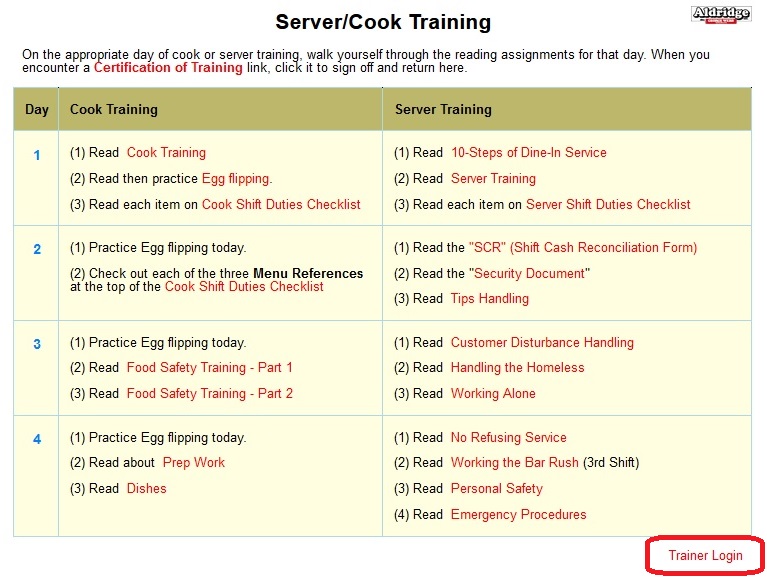
- Referring to the image below, each day, the trainee must read for a dedicated period of time, typically about 20-30 minutes.
- Do not have them sit down right away for reading. Wait until about an hour into the day, then have him/her sit down in back with a coffee or soda, and read the appropriate day's area
- Inform the trainee showing the training area of the tablet, including specifically what area to read each day
- Each day has a different reading area, Cook Day 1, Cook Day 2, etc.
- Show them exactly what to read each day
- If you happen to miss a daily reading, double up the next day
because it's very important that they read everything!
Daily Evaluation
Now on the image below again, notice at the bottom right, is a link Trainer. Each day, please click that link and fill out the day's evaluation on the trainee. It gets emailed to Tom. When you click it, it will ask for a User Name and Password, which is (user) "excellent" and (password) "trainer".
Certification of Completion
Please certify that you have read this training module click here.
https://bit.ly/3PwfOYl